Showing posts with label 2016 election. Show all posts

Thursday, May 14, 2015

Once More, Unto the Breach Dear Friends

In the aftermath of the 2012 election, where GOP big shots from Karl Rove down to Mitt Romney sat stunned because they believed that the election was in the bag (and should have been in the bag), the GOP began a round of soul searching, as well as finger pointing (who can forget Mitt's double down comments crediting Obama's re-election to "gifts" to a variety of parasitical citizens)?

In the aftermath of this soul searching, the GOP produced a fairly interesting and revealing introspection about how the party would need to change if it wanted to win presidential elections, starting with the open-seat election in 2016.  The result of this introspection is a 100 page document titled the "Growth and Opportunity Project".  On page 69, the article focuses on the primaries, and especially the debates that took place among the potential nominees.

The authors note that in 1980, there were just six debates. In 2000 there were 13. But then in 2008 and 2012, the number of debates exploded, with 21 and 20 respectively. Furthermore, in 1980, the first debate did not take place until the Iowa Caucuses were about to begin, while in 2012 the first debate took place eight months before Iowa:
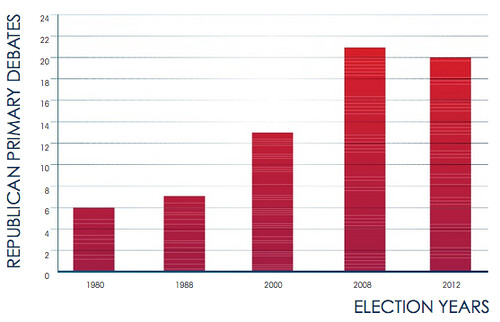


 In addition to the large quantity of debates, there was the added problem of two debates held back to back within a 12 hour period--the first in the evening on Saturday January 7, 2012 and the second in the morning on Sunday, January 8, 2012.

The authors argue that it is time for the Party to get control over the timing, sponsorship, and candidate participation of GOP debates because currently the GOP brand, and candidates, are being hurt via a collusion of the liberal media and unelectable candidates who push for more, and not less, debates.  They note:

The media will decide how many debates the party should have instead of the Party making the decision. In order to have a process that respects a candidate's time and one that helps the Party win (71).

 Their recommendations for 2016:
  • Hold between 10-12 debates beginning no earlier than September 2015 and ending somewhere around Super Tuesday in late February or early March.
  • After the last round of debates, if there continues to be a competitive battle between two or more candidates (similar to 2008 for the Democrats), then it should be up to the candidates to decide if they want to accept or decline additional debates
  • The RNC needs to get control of the scheduling process as soon as possible: by announcing the number of debates as well as when they will begin in late 2014 or early 2015, before the field of candidates has had a chance to get set. Further, the RNC should penalize any candidate or state party that defects from the schedule by attending non-sanctioned debates (or hosting non-sanctioned debates) by taking away delegates going into the GOP Convention in the summer of 2016, or more realistically, by barring from sponsored debates the participation of candidates who appear in non-sponsored debates.
The RNC did announce its schedule of "sanctioned" debates: five in 2015 and then five more in 2016, with the first one held in Cleveland (also the home to their summer convention) on August 6, 2015 and the last one in March 2016, location TBD.  And no mystery, the big winner as far as hosts go is "Fox News" (or its subsidiary, the "Fox Business Channel"), which will air four of the debates.  In addition, the conservative Salem Media Group is also a big winner, sponsoring three of the debates.

The paper underscores a long standing tension between political parties, candidates, and the media when it comes to who or what matters during election time.  Back in 1969, the McGovern-Fraser Commission changed the control over the selection of party nominees, removing it from the party leadership and handing it over to the rank and file voter in the 50 states and territories.  As a result, who mattered in presidential elections shifted from Party-Candidate to Candidate-Media.  In fact, we can lay a great deal of the blame at the feet of the Democrats for agreeing to implement the Commission reforms, because it brought with it the need for incredibly enormous sums of money and a near dependence upon political advertising (one going hand in hand with the other). Furthermore, it removed the party from having any influence over the choice of nominees, often getting stuck with the least desirable candidate.  More recently, the political parties have been trying, with some success, to regain control over the selection of candidates and the direction of campaigns (see, for example, Groeling's When Parties Attack: Party Cohesion in the Media. NY: Cambridge University Press. 2010).


Jonathan Martin, writing in yesterday's New York Times, draws attention to the problems the GOP faces as it rushes headlong into the 2016 election cycle with a number of top shelf and bottom shelf candidates, versus the Democrats, who have Hillary Clinton and not much else (with all due respect to that loyal Bernie Sanders contingent).  The article also illustrates a particular problem regarding who gets to decide who appears in those debates sanctioned by the GOP.  From the lede:

Republican leaders, searching for a fair-minded but strategically wise way to conduct the presidential primary debates, are grappling with how to manage White House contenders in a sprawling field that mixes proven politicians with provocateurs and reflects an increasingly fractious party.

 At the moment, there does not seem to be a fair way to decide who appears and who does not.  As Martin argues, relying on polling could preclude current or former GOP politicians from participating because they may not be well known to the public at large.  What is especially ironic, or delicious, depending on your political views, is that public opinion polling is the weapon that the Democrats and Republicans use to keep third party candidates out of the presidential debates, and no one from either Party or from the Commission on Presidential Debates suggest any problems exist from using public opinion polling as a barrier to entry.  The problem for the GOP is relying only on public opinion polling to decide who participates or not is likely to be the very thing that pushes candidates into appearing in non-sanctioned debates.  And if some attend the non-sanctioned debates, you can bet most, if not all, will attend.

The GOP face the additional problem of optics in winnowing the field.  From Martin:

Many Republicans laboring to improve the party’s image recoil from the prospect that whatever debate-eligibility criteria are adopted could result in the barring of the only woman, Carly Fiorina, the former Hewlett-Packard chief executive, or Ben Carson, a retired neurosurgeon who is the only African-American candidate.
But if they decide to allow Fiorina and Carson to attend while cutting other candidates such as my State's Governor John Kasich, the GOP face the additional problem of appearing to embrace affirmative action. 

So how does the GOP leadership see a way to resolve this problem?  As Martin notes, for the first debate in August:
One member of the national committee panel charged with overseeing the debates said its members had discussed ceding the decision entirely to Fox News.

So pass the buck is your answer?

It may just be that the GOP leadership is looking at this in the wrong way.  While I am sympathetic to the problem of over exposure--too many debates--as well as over simplification--too many people on the stage forces each person to boil down complex arguments into bite sized nuggets due to time constraints, the GOP should be asking themselves just what do debates in general accomplish? What impact do they really have on the eventual decisions that American voters make in November?

Martin seems to believe that debates do make a difference.  He argues: "...as the 2012 primary demonstrated, televised debates can instantaneously reshape presidential races...".

He also suggests that candidates who do get excluded as a result of the criteria that the GOP, in conjunction with the media, develop will take their anger to

...conservative websites and talk radio to foment anger at the so-called Republican establishment — an assault that could undermine the national committee’s hold on the debate process.

If you believe people like John Sides, these pre-primary and primary debates do not matter much in affecting the electoral chances of the eventual nominee.  In fact, the benefit from these debates is two fold (at least):

First, it does act as a kind of training ground for the eventual nominees, who will only get three chances to debate one another in the general election (the list of potential debate sites is currently available at the Commission on Presidential Debates).

Second, these debates can save the party from making a very bad decision on a candidate who may be a media darling, but is nowhere near ready for prime time (think former Texas Governor Rick Perry).

It seems to me that the problem of superficiality, which some critics believe stems from too many candidates in the race, is less a result of the number of debates or the number of participants, and more the result of the media's role in the process, starting with sponsorship of the debates.  Each one of the ten GOP debates is sponsored by a media organization--either cable or broadcast television.  And if you recall the 2012 primary debates, the media coverage, coupled with the questions asked, were down right offensive to the intellect of the audience.  Examples?

In the June 2011 debate that CNN sponsored, the moderator, John King, said this:

All right. I want to -- got to work in one more break before we go. We've got a lot more ground to cover. Believe it or not, our candidates -- we're running out of time here.

Into and out of every break we're having a little experiment called "This or That."

Governor Pawlenty, to you, Coke or Pepsi?

PAWLENTY: Coke.

Or worse yet, who could forget the CNN "Tea Party" sponsored debate in September 2011, which had an introduction that was straight out of Monday Night Football or professional wrestling, or this from intellectual powerhouse Wolf Blitzer:

“Tonight, eight candidates, one stage, one chance to take part in a groundbreaking debate. The Tea Party support and the Republican nomination, on the line right now.”
And finally, regarding the worry about the power of the  fringe to take to conservative media and to bring down the Party is giving to much credit to the fringe and to conservative media.  As John Sides and Lynn Vavreck argue in The Gamble, one of the mistakes that Mitt Romney made in the primary back in 2012 was to over-estimate the power and the size of the Tea Party faction within the GOP, forcing him to take conservative stands when he did not need to.  And political talk radio, once a force in American, and Republican, politics has disintegrated as a result of an aging audience and the continual fragmentation of our media into a million little pieces.

It will be something to watch as 2016 comes closer into view to see whether or not the Party, or the candidate, has real pull in the election cycle.  But if the last two election cycles are any guide, having fewer debates is not likely to happen in 2016, or in any other presidential election cycle to come.


Thursday, March 5, 2015

50 Shades of CPAC

50 Shades of CPAC

We’re back! For a variety of personal and professional reasons, the two primary contributors to this blog have been on something of a hiatus since last summer. Speaking for myself, I’ve been as busy as I’ve ever been in my professional life trying to make demonstrable progress on four working papers under a 3-3 teaching load. There are times I truly envy my friends in the private sector who only have to work 40-50 hours over a five day work week…

In an attempt to hit the ground running, I’d thought I’d elaborate a bit upon John Sides’ take on this go around of the annual CPAC conference. In perhaps what is the best commentary I’ve seen on the event yet, @monkeycageblog tweeted out this gem:


Let me preface the discussion with this: within my short life as a political scientist, I’ve seen clear changes, good progress really, in how the media covers the invisible primary. A decade or so ago, if the words “invisible” and “primary” happened to collide together in the same sentence, your average journalist, perhaps political scientist even, wouldn’t have had the foggiest idea of what it was referring to. Compare that to the last couple of presidential election cycles where reporters have routinely begun to refer to the process and report on it in a much more informed fashion. This is clearly a case where political science’s engagement with journalists has had a positive impact on popular media coverage. Despite this wide recognition of the importance of the invisible primary in steering the parties towards nominees on the part of a growing number of journalists, the media tends to focus on invisible primary events that are most conspicuous. And in this instance, it means focusing in on the wrong place.

The problem with the CPAC conference is that this particular piece of low hanging fruit is probably the least useful in getting a grasp on which candidates are in doing best in the ongoing deliberations amongst policy activists within the Republican party network. The history of success at CPAC is far from perfect in predicting the eventual nomination. Let’s face it, the comments of a few fringe candidates make for interesting news items, despite the fact that they test my faith in democracy in general and more narrowly make me wonder how I ever had sympathies with this particular crowd in years past (yes, it can be painful, hence the title). Couple that with the fact that the straw poll gives a nice quantifiable capstone to the event, you can see why journalists pay it a great deal of attention. However, CPAC is at best a snapshot of the opinions of a few of the “fringier” factions within the party. Libertarian-ish types, check; Populist Tea Party-ish types, check; a good showing of Republican office holders, [crickets].


We know from experience, that the support of members of congress, governors, and other elected office holders is absolutely key in winning the invisible primary because of the organizational resources that they bring with them and the cues they give to others in the party. Voters do indeed take heed to the opinions of the "elite". When the key party actors aren’t present in force for the conversation taking place at CPAC, whatever visible cues we get from conference will be a mighty incomplete picture of the party wide deliberation. 

So props Senator Rand Paul for his continued sweep of this series. And, a shout out to Scott Walker for nearly pulling off a dark horse win. But when you’re a dark horse behind Rand Paul, from a crowd that barely resembles the key constituents of the Republican party network, neither of them, nor Republicans, nor the general public, should be taking any of these results to the bank. I dare say we should stick with Prof. Sides, and look elsewhere for clues as to who's really cleaning up in the invisible primary.

Sunday, March 30, 2014

How to Report the Invisible Primary

Thus far in the invisible primary of 2016 we've seen plenty of terrible reporting from all quarters of the press that are frankly too numerous to count, much less link up here.  However, there's some really good stuff going on out there.  For my money, Robert Costa of the Washington Post is quickly establishing himself as my personal favorite, as his coverage has really focused on what matters in things invisible primary.  A hallmark of the junk tends to be heavy on the various match ups for 2016 or even worse, the results of horrifically unrepresentative straw polls such as what we saw coming out of CPAC several weeks ago.  Not so for Costa...

Whilst multitasking between Fareed Zakaria, watching the T20 cricket championship (Australia, what are you doing?), and scanning headlines, I ran into this article by Costa and his colleague Phillip Rucker.  Kudos to them both.  

Let's set aside Jeb Bush's chances for winning the nomination for the moment, and focus on the coverage itself, as this is good stuff from the perspective of political scientists.  They quite literally are covering all the bases that matter.  First, they recognize that this isn't just a matter of a candidate trolling for support within the various parts of the party establishment, but the various parts of the party establishment actively vetting a candidate, or as they put it a "draft" is underway.  Second, they recognize the players here are a diverse network and are deeply concerned about both policy and the political feasibility of the noisiest candidate of the moment, Senator Rand Paul.  Third, they hit the importance of money at this point, and not just ability of Bush stuff his own coffers, but as I've noted before, make it rain for other Republicans across the country.  Fourth, they have a nice discussion on the strengths and weaknesses Bush brings to the table and how they will play to the various factions of the party.  If reporting the invisible primary was a four-banger of a motor, they'd be firing on all cylinders.

And here's where I really appreciate their work and where they separate themselves even more from most of their competition: While they eventually get around to some poll numbers and the (possible) issue of "Bush fatigue," it's at the tail end of the article and well embedded in a nuanced discussion of the factors that matter.  And they're not referencing some idiotic "Jeb vs. Hillary" face-off that litters most coverage at this point, but focusing on factors unique to Gov. Bush.  When we cannot even begin predict what the fundamentals of the 2016 contest will be, those sorts of head to head polls are superfluous.  

Overall, nicely done gentlemen!  I for one, will be following both these people's work rather carefully, as should you all.


Sunday, October 6, 2013

There's More to It than Being on TV

I thought I'd rip off a quick post here not so much as to offer some new and profound thoughts on the pre-primary, but to give us all a quick reminder what the invisible primary isn't either in theory or in practice.  As this is my first chance to watch a live game on Sunday this season I'll make this brief.

A lot of ink has spilled and pixels darkened about Sen. Ted Cruz and his apparent 2016 ambitions.  As many would have us believe, grabbing the limelight is the first order of business for presidential hopefuls at this point in the election cycle.  While this may help a candidate's invisible primary strategy, let's not forget a couple things.  

First, the invisible primary isn't all about candidates going to the people; it's a conversation that takes place within a party (broadly defined) as they seek candidates.  This isn't to say that candidates actions are unimportant in invisible primary success, they're just less important than many folks assume.  Several, if not most, of the invisible primary winners (think George W. Bush) weren't out playing a public game at this point.  Quite importantly, Bush wasn't out there pissing off anyone in the party at this time in 1997, he was making nice with nearly every GOP governor and other well placed Republicans whilst they were vetting him. 

Second, Sen. Cruz's faux filibuster has only appealed to a narrow band of the Republican electorate.  While the talk of a Republican civil war is in no doubt overblown, he is irritating a rather important wing of his party.  As the invisible primary is in largest part a party-centric enterprise, simply gaining public standing in one faction of the party, while simultaneously alienating another isn't the best course of action.  The Tea Party may be a plurality, or even a majority of the party at the moment, but those simple numbers don't guarantee success.  We know that when the party does land on a strong general election nominee,  faction leaders tend to lose out in the invisible primary in favor of another candidate that isn't any faction's first choice, but is nevertheless unobjectionable to the mix of constituencies within both parties.  

So if Sen. Cruz is seriously pondering a presidential run, he'd best start playing nice with his colleagues and worry about broad party goals as well as his own personal electoral ones.  If he blows off the better part of his caucus, he'll in no doubt be in a good spot for reelection, but he'll be shooting himself in the foot for higher office.

Wednesday, October 2, 2013

The invisible primary in hiding.


It is tempting to want to unload over the current budget and impending debt limit crisis.  There is so much to say, so much grist for the mill.  But most of it has probably been said and, besides, this blog is about the invisible primary so, is there anything to say about it given the current distraction?

How about Paul Ryan’s almost no-existent roll in all this?  He is, as I remember it, the Radical Right’s wonder-boy when it comes to the budget.  But he has almost nothing to say.  In realty, his former obsession with Medicare might actually be a better fit as a bargaining chip for the GOP.  Medicare actually has a big impact on the current and future federal budget, certainly more than the ACA by most assessments.  I mean, if you are going to hold a hostage, you might as well get what you want for its return straight.  It is like someone stealing my cat and demanding a ransom from my proctologist (not that I need a proctologist….).  More accurately, it is like kidnapping your own child, and demanding ransom from their sibling for her to be returned.  You both want her returned, you will make sure she is going to get returned, you were just too stupid not to hold the Dora the Explore DVD in return for the ransom.

Interestingly enough the one glimmer you see of him is fundraising over the issue for his leadership committee, Prosperity PAC.  And his dealings over this issue are not the only place he stays hidden.  In August, as these issues began to percolate, he attended a highly secure and secret meeting with the Koch brothers in New Mexico.  Does his public silence on this tip his hat to a view that this battle may not be good for a presidential run?  Given the leadership vacuum in the House, this would be a good time for him to try and give clarity and logic to the Tea Party message.  His potential challengers, Cruz not withstanding, have been equally quite or even somewhat critical of the approach adopted by the radical minority of the GOP.  Marco Rubio weighed in on the faux-filibuster with Cruz, but just enough for the people who care to notice.  In fact, except for Cruz, the Senate Republicans really want little to do with all of this.  Chris  Christie criticized the approach, but his position has to be taken in context of an impending reelection as governor.  Jeb Bush, critical; Rand Paul, mostly silent; Scott Walker, silent; Condoleezza Rice; silent (yes, I am the first on this blog to suggest she could be a conten-da).  Rick Santorum, he is talking about it, but I addressed him last week in my entry.

I think one reason why Ryan, and some of the other invisible primary contenders, are staying silent is because they are interested in governing and this is clearly not governing.  So they have that going for them, which is nice.

Tuesday, September 24, 2013

Fall = Best Season Ever

And we're back! Late September formally brings us academic classes in full swing and autumnal glory where all college campuses look like they do in the brochures. Crunchy leaves, sweater-wearing students, cheerful football games and underage drinking. Ah, September. On a personal note, my students this semester are fabulous! They totally make up for the feces-fest unraveling now on Capitol Hill, because watching that is enough to discourage even a stalwart, system-adoring political scientist. Here's to a new generation!

But first, let's look at the current state of affairs.

This September brings us another perennial nugget of joy: the threat of a government shutdown. Unless you have been completely distracted by the WORLD'S BEST COMMERCIAL (as, I confess, I have been at times where distraction is necessary), you know about the looming crisis and the resulting rift in the Republican Party. If not, please let this terrific article explain for you the coming week (courtesy of my friend and fellow blogger, Lonce). And sorry for stealing this, Lonce. You an also check out this good one from Politico (like they do anything badly?).

Since this entire kerfuffle is political theater, you just know there has to be Invisible Primary drama behind the scenes and so we begin with the thespianism on the floor of the US Senate right this minute! Quick! To C-SPAN 2 (the Deuce)! Texas Senator Ted Cruz (R) launched an old-fashioned filibuster (ala Mr. Smith) against Obamacare and vouched to speak "until I am no longer able to stand." Good on you, sir, and this comes after a bruising little amount of press that called you a bunch of names and also questioned your popularity. It's good to stand for something, especially when you actually have to stand in order to stand for it.

But the possible shutdown tactic is splitting the GOP which is never good, unless you are a Democrat. Specifically, the 2016 IP contenders have to weigh in on this and thus far the results are mixed. Republican Governors Chris Christie (NJ) and Scott Walker (WI) both begrudgingly said that they would not want to shut the government down, as did former Florida Governor Jeb Bush. On the other side are the aforementioned Cruz and Sen. Mike Lee, and sorta kinda Florida Sen. Marco Rubio who seems to want it both ways by saying that "The American people support defunding Obamacare and oppose shutting down the government." OK! Not sure how that works out, but here is PolitiFact's take on Rubio's press statement.

So how is it going to end? Good Lord, who knows? I do know that Veep Biden schlepped out to flood-devastated Colorado and promised that regardless of any shutdown, FEMA would provide assistance to those in need which was both reassuring and tactically savvy, all at the same time. Last week, Biden was in Iowa at the Tom Harkin steak fry, which fueled speculation that he was, in fact, running. At the fry, he swapped hats with an Iowan for a photo-op, which only fueled my motherly instinct to yell "DON'T DO THAT!" as a preventative measure against head lice. Joe, don't say I didn't warn you. And don't share your comb or barrettes either.

Wrapping up this week in the Invisible Primary, last night former President Bill Clinton was on David Letterman, who was fishing for Hillary 2016 scoop. Letterman said: “If she is running to your knowledge, blink twice.” Bill denied all knowledge of his wife's intentions, which did not seem to surprise me in the least. Fair turnabout, don't you think?

That's all from the cheap seats. if the government shuts down, I tell my students, the price of pizza is going to sky rocket and beer will be banned in all 50 states. They don't believe me. See? What a smart, terrific group I've got! Hooray for September. And Happy Fall everyone!


Tuesday, July 2, 2013

Coffee House Guy, the Money Primary, and the Invisible Primary


Over the past two weeks I was lucky enough to take a bit a of road trip to Oregon and Washington to visit a dear friend and family before the nuttiness of preparing my house for sale and moving up to South Dakota State (Go Jacks!) begins in ernest.  Generally when I'm on the road I don't make a particular point of socializing with random folks, and my first general order is to never blurt out that I'm a political scientist to strangers.  As my colleagues in the profession can attest to, that can elicit a wide variety of responses, the vast majority of which we'd rather not hear.  However, at a moment of weakness in a coffee joint in Park City, I was pinned down with an incriminating pile of manuscripts awaiting editorial action by coffee house guy.

After his finding pretense to engage me, exchanging pleasantries (which I suck at by the way), explaining what I was up to, and my areas of interest, we had a decent little exchange on presidential elections that got me thinking.  Here's the critical bit:

CHG: So who's the odds on favorite for the Republicans?  After all, we know Hillary will be the nominee for the Dems, since she's got all the money.

Me: Obviously it's too early to make an accurate prediction, but I'd look for someone who's got a good reputation amongst Republican governors and perhaps Senators, and can get along with the Tea Party types, evangelicals, and the country club set... maybe someone like Rob Portman, hell even Jeb Bush if he can restore the brand name.

CHG: What about Rand Paul?  He's got a bunch of hardcore supporters and can probably tap into his dad's great fundraising network, and money's the name of the game in the primaries.

Me: Money is one of those things you can't do a thing without, but it's not everything.  And, it can't be flowing in just one direction towards the candidate.  Early on, it's more important that the candidate be raising money for other folks and the parties at various levels.  Both Ron Paul and Howard Dean were raking the money into their campaigns in the early primary seasons and both had their asses handed to them when the voters began to weigh in.  Their opponents had developed networks of office holders and party activists that could open up the taps when the time came.

CHG: Makes sense.

Me: Yeah, I wish I was the one who wrote the book on that...

CHG: So Hillary's not got it in the bag either.

Me: No, but she's got a lot more going for her than money.  Unless something big happens between now and then, as it did in 2007, she'll be well positioned with Democratic office holders and activists for a strong run.  She'll raise money for them and they for her; to say nothing about the pro staff and volunteers she'll pick up in the process.

CHG: What about those 501 groups?

Me: Yeah you're spot on, just another way for the money to be raised and spent between the players.

CHG: Well good talking to you, take it easy bro.

Me: Uh, yeah.  You too, um dude.

***

The money primary and invisible primary are often conflated, but I think we need to carefully separate the concepts, and be very clear about the nuances of money in the process.  All things considered, I'm all for retiring the use of the term "money primary" all together as it obfuscates more than it clarifies.

For starters, the invisible primary clearly involves money, but it's not determinative.  The term "money primary" evokes a candidate centered process, reminiscent of David Broder's famous observation that politicians are essentiallyself-nominated and financed political entrepreneurs.  This feeds into the widely, yet wrongly held belief that money is everything in politics.  Central to the concept of the invisible primary is that the party - broadly conceived - is attempting to triangulate on an acceptable candidate.  It's as much - if not more - about the various constituencies and officials within the party looking for a good nominee as it is self-starters looking to tap into the organizational and financial resources of the party's principle players.

By conceiving of the pre-primary period as simply the money primary, we lose a great deal of what's taking place within the party.  A commonly held belief about Gov Tim Pawlenty's hasty exit after the Iowa straw poll was him losing the money chase.  While his fundraising clearly was falling behind Romney's, we now know that his real trouble was finding bannermen amongst well placed Republicans.  While there's clearly some simultaneity with money and party support going on, history shows us that party support is the critical factor.  And as I suggested to the coffee house guy in Park City, the entrepreneur like Dean in '04, who pads his own pockets nicely, but fails to pad the pockets of others in the invisible primary, will probably take an inglorious early exit.

Monday, June 17, 2013

Slow News Days = IP Expansion


Have you ever noticed that on the days where there is no real news, the crap stuff seeps in more readily? This is not to say that on a good news day there is quality stuff out there, but when the NSA is poking into our business, at least the big three plus the cable news nets pay a modicum of attention to issues that… I don’t know… matter.  

And speaking of the NSA, just a quick story: When my husband deployed to Afghanistan in 2001 I was left behind on Fort Drum, the Army’s 10th Mountain Division (Climb to Glory!). Since this was the very first “real world” deployment in a long time, even experienced Army wives didn’t know what to do and I was far from qualified to understand anything. I pretty much just stood there and looked confused. Of the precious few pieces of advice I was given: The mail will be slow, “JAG” was not just a bad TV show and you needed them to fill out paperwork, and your phone calls would be monitored. Thus, when we were talking 14 times a day, my sister and I got into the habit of saying “hi” to those we referred to as the ‘men on the phone.’ Sometimes we gave them recipes because we’re friendly like that. So this NSA stuff? Sort of old hat. Hello again, my men-on-the-phone friends! Hope you liked that Yankee Pot Roast recipe we spoke about a decade ago. Somebody remind me to add a salutation now in my outgoing e-mails to the nice people at Verizon and at Fort Meade. Moni and I have a killer salmon recipe for you! Perhaps a poor choice of words….

Now back to the Invisible Primary.

Last week seemed to be all about my gal Hillary, whose activities seemed to be continuously and unimaginatively described as: “Fueling speculation of a 2016 run.”  She rather coquettishly leapt ontoTwitter, describing herself as “wife, mom, lawyer, women & kids advocate, FLOAR, FLOTUS, US Senator, SecState, author, dog owner, hair icon, pantsuit aficionado, glass ceiling cracker, TBD…” and set the Twitter-sphere afire with loads of new followers jumping onto the bandwagon with alarming alacrity. She also spoke at the newly re-named “Bill, Hillary, and Chelsea Clinton Foundation” where she talked about early childhood education, always a decent issue upon which to campaign (the children is learning).  So she’s getting good press, but all readers of this blog know that the media spotlights are hot things and coverage is capricious. Thus, the news that HRC is slipping a bit in the polls was both newsworthy and unsurprising at the same time.  Ah, media attention: You fickle, fickle lady. The reason for the slip in the polls concerns, of course, the Benghazi affair which conservatives have locked onto like… conservatives onto the Whitewater Affair circa 1993. Huh. Anyhoo, a no less vaunted publication than Commentary has seized this moment to pile on and released this little nugget of joy about Hillary’s piss-poor performance at State, alleging not only did she cock up Benghazi, but under her watch the whole ambassadorial corps was riddled with sex scandals, a different type of cock up if you ask me (zing!). Suffice it to say, Hillary takes the media lead this week in our Invisible Primary, if only because of her seemingly road-block coverage of her Facebook-style “selfie” pictures. Oh, and by the way FLOAR stands for First Lady of Arkansas, so get your head out of the gutter.

Moving on to another relative of another past-POTUS (actually, two past POTUSES. POTI?), a warm welcome back to the IP to Jeb Bush, who spoke last week to the Faith and Freedom Coalition’s annual bacchanal (just kidding!) in Washington. Jeb, trying to get in front on this immigration issue, said the following: “Immigrants are more fertile, and they love families, and they have more intact families, and they bring a younger population. Immigrants create an engine of economic prosperity.” This truly bizarre statement brought out the funny from (never thought I’d say this) Sarah Palin, who remarked to the conference the next day: “I think it’s kind of dangerous territory . . . to want to debate this over one race’s fertility rate over another. And I say this as someone who’s kind of fertile herself.” Basically, Chris Cillizza in the WaPo had a nice piece here about the establishment vs. hard right kerfuffle in the GOP that is worth perusing if you haven’t already. This out-in-front strategy of Jeb’s is fodder for “will he or won’t he” 2016 speculation, but since his mom put the kibosh on it we can move along…

… to Chris Christie, who remains a media darling thanks to a crap-ton of press  he has garnered following the death of NJ Sen. Frank Lautenberg. Calling a special election for October brought mixed reviews, but the Governor barreled through to “slow jam” the news with Jimmy Fallon, share an acclamatory stage with Bill Clinton, and then watch as his Gallup poll numbers rise to make him the most popular IP 2016 contender of the moment. Christie is on top right now as he walks towards his own 2013 gubernatorial re-election bid. He’s stealing a play from Hillary herself from the time that she ran for her Senate re-election in 2006: Raise a truck-load of money, spend bupkis, and keep the campaign cash in your war chest. You know. Just in case another election just happens to come your way. Maybe in 2016?

Oh, who knows. Wait. I know someone who might: Hey, NSA! What do you think?
OK, OK. Go back to keeping us safe for democracy or whatever. Really: I love your work. Have you lost weight? Hope you enjoyed that Yankee Pot Roast.

Big hugs to the men on the phone,
Ali

Wednesday, May 22, 2013

“We’ve Only Just Begun!” The IP Graduation Speech From Hell


‘Tis the time of year when chestnuts are roasting – not the kind of chestnuts that Bing Crosby sings about in December, but the old kind that gets tossed around graduation speeches like hacky sacks at a Further concert. Yes, these are the worn-out, unimaginative clichés that riddle university campuses, positioned right after the non-denominational prayer, right before the singing of the alma mater, right around the time the frat boys start to get woozy from the wake & bake and the sorority girls realize their shoe selection was unfortunate for a four hour event where most of it is spent standing.

The world is ahead of you.
Look forward, but also look back.
It is not the end, it is the beginning.
Life is a journey.

So true. So, so true. ALSO, so freakin’ stale they make my eyes roll reflexively. Thus, this IP posting will take these hackneyed phrases and put them to good use: to address the conundrum of how to “run” for office when you are not actually “running” for anything. Because you must walk before you run. And you will fly and soar as far as your wings will take you.

Good. Lord.

OK! Cliché Numero Uno: The world is ahead of you.
This one is dedicated to my girl, HRC, whose world now consists of her “transition office,” the nation of Libya, and the ten foot circumference around Sen. Rand Paul’s tuchas. The multi-perspective view of Hillary’s world begins at the same place but ends very differently: She is aiming for the White House using her experience as evidence of greatness, and Sen. Paul is aiming for the White House using her experience as evidence of skullduggery. The fun, of course, is in the spin. She says she done good as Sec State, he says she should be in prison. Potato, potahto. The interesting story to drop recently was that some of the big-wigs from Clinton’s 2008 campaign have begged off another chance at the gold ring, but as anyone who has visited my hometown knows: The place is lousy with big-wigs. And, apparently, locusts. But let’s not get distracted.

Cliché Numero Dos: Look forward, but also look back.
This goes out to IP fave Sen. Marco Rubio who has taken advantage of the IRS kerfuffle to propose an amendment to the upcoming 2013 Farm Bill (?) that punishes IRS officials who violate the constitutional rights of Americans. Sayeth the good Senator: “This IRS scandal has destroyed the American people’s confidence in this government institution and exposed the dangers of a large, unaccountable government operating under a President and administration that routinely intimidate and harass their political opponents.” Holy cats – knocking the administration AND the IRS in one fell swoop? Nice IP play, sir! Well done. Also, and I’m just whiffing here, it seems that throwing stones at the IRS today is sort of like proposing a Fight Club brawl with Olivia, your 6 year old niece. Who is blindfolded. Sorta easy, ain’t it?

Cliché Numero Tres: It is not the end, it is the beginning.
And hellllooooo NYC Mayoral Candidate Anthony Weiner! (You didn’t think I was gonna let this one go, didja?) I only have three things to say here: One, welcome to the race of a lifetime. Hot dog, this is gonna be FUN, even from the cheap seats. Do you think the New York Post just hired four new cover editors? Two, Congressman, I was wrong about Mark Sanford. But you are no Mark Sanford. Three, are you ready for more (much more) of this? I am proud that this video nugget was created by “a former student working in political consulting or advertising or whatever.” His words not mine, because I got clearance to give him a blind-item shout out. But anyway, Anthony, strap yourself in for more of this. Much, much more. And don’t say I didn’t tell you to wait.

Finally, Cliché Numero Quatro:  Life is a journey.
In this case, a journey to Israel. Mazel Tov to Democratic Maryland Gov. Martin O’Malley who recently schlepped to the Middle East in order to talk shop with the chosen people, sharpen his Foreign Policy skills, and prove he’s got what it takes to run for the White House. We haven’t spoken about O’Malley in this blog YET but apparently this is an oversight. He went to Iowa (another designated IP destination) and he’s openly talking about 2016. A bold move from a bold man… that no one outside of Maryland has ever heard of. The good news: There’s still time!

And so graduates, faculty, proud parents, and blog readers: Keep reaching for the stars. You are the future, your education is just beginning, believe in your dreams and always remember: You did it. What you did is between you and your conscience, but I’m a liberal so I say go for it.